Color blindness, or color vision deficiency (dyschromatopsia), is often misunderstood. People imagine someone who sees only gray, or who always mixes up red and green. The reality is more nuanced.
A difference in telling colors apart
Color blindness is not an inability to see color. Color blind people do see colors, but their ability to tell some of them apart is reduced.
How many colors do you lose, exactly? The question is trickier than it looks. The figures that circulate all over the web (“a color blind person sees 10,000 colors versus 1 million for everyone else”) are not based on any identifiable study.
What we really know: by analyzing hyperspectral images of 50 natural scenes, a team at the University of Minho estimated that a normal trichromat eye can tell apart about 2.3 million colors in them¹. For a dichromat, someone who completely lacks one type of cone, like me, that volume drops to about 7% of the total².
Except that this figure gives a misleading picture. When the same team stopped computing theoretical volumes and put real dichromats in front of real lit objects, the result was quite different: they still distinguished nearly 70% of the color pairs that trichromats distinguished³. The study is small (four dichromats, four trichromats), but its explanation is convincing: the color pairs that really trip us up are rare in nature, and a good half of the distinctions rely on brightness rather than on hue.
In other words: my color space is collapsed on paper, but the world is built in such a way that I rarely notice.
In practice: a red-green color blind person doesn’t see red and green identically. They can tell them apart under certain conditions (strong light, high contrast), but lose that ability in others (pale colors, low light, ambiguous context).
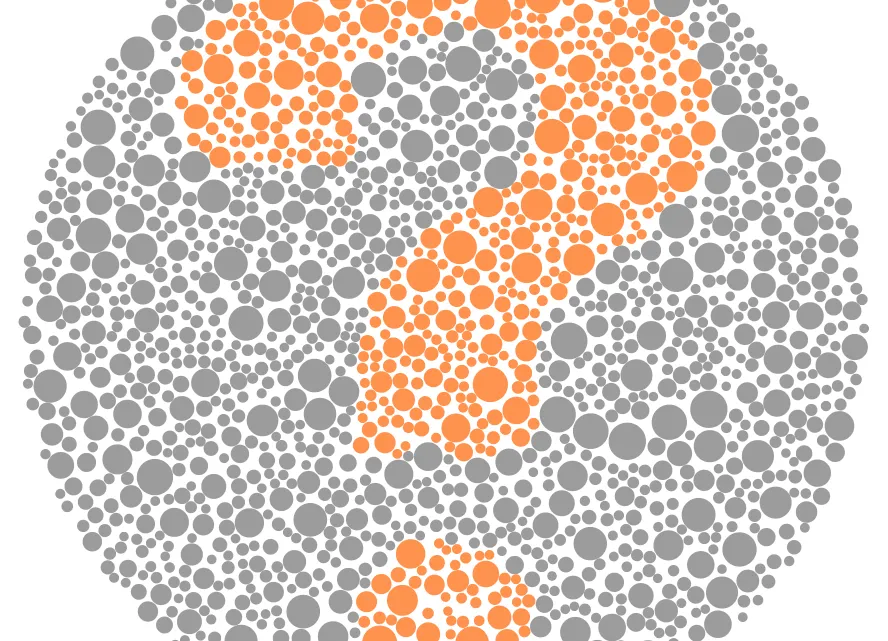
A concrete example: most color blind people can’t see the number in this Ishihara plate.
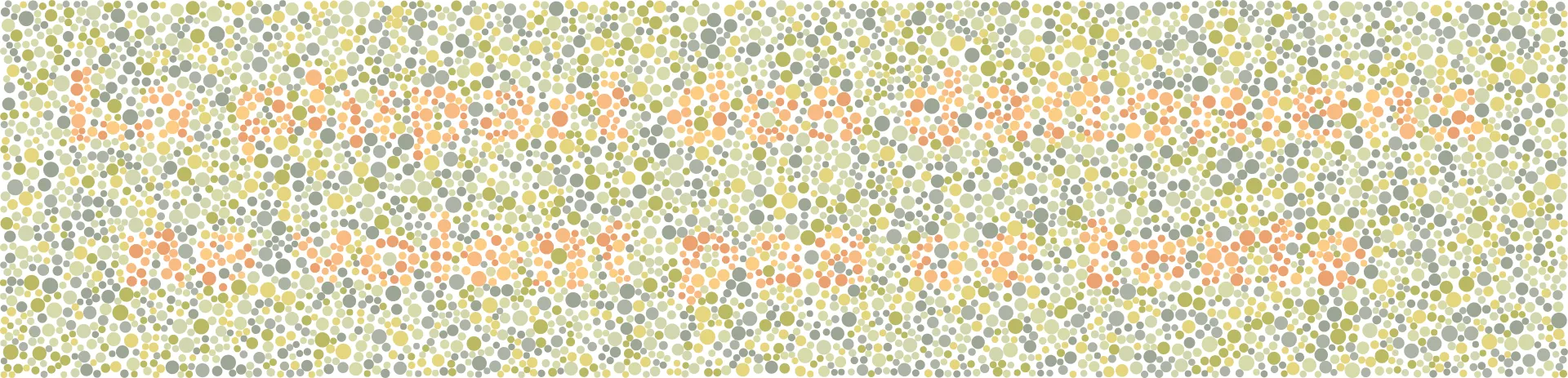
If you have never taken a test, the online Ishihara test is a good starting point, and I explain what these plates really measure in a dedicated article. To see the opposite, not what you can tell apart but what a color blind person would see in a photo of your choice, our simulator applies the filter directly in your browser.
What are the types of color blindness?
There are three families of color blindness depending on which cones are affected: anomalous trichromacy (one cone is shifted), dichromacy (one cone is missing) and monochromacy (no working cone).
Color blindness results from the malfunction of retinal photoreceptors called cones. A typical eye has three types: L cones (sensitive to red), M cones (green) and S cones (blue). Depending on how many cones are affected and how severely, we distinguish three families.
Anomalous trichromacy: all three cones are present, but one of them is shifted:
- Protanomaly (shifted L cone)
- Deuteranomaly (shifted M cone), by far the most common form
- Tritanomaly (shifted S cone)
Dichromacy: one type of cone is absent or completely non-functional:
- Protanopia (no L cone)
- Deuteranopia (no M cone)
- Tritanopia (no S cone)
Monochromacy: no working cone:
- Achromatopsia: vision only in shades of gray, about 1 case in 30,000. It almost always comes with strong light sensitivity (photophobia) and reduced visual acuity. It is a condition in its own right, not simply “more severe color blindness”.
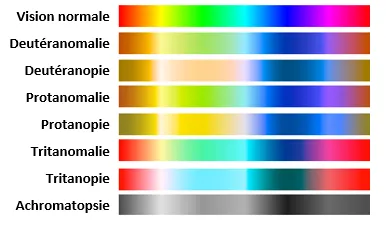
Everyone has a unique configuration. Some people combine several types of deficiency. Personally, I’m a protanope, strongly deuteranomalous and slightly tritanomalous, one combination among dozens of possible ones. I go into all this in the types of color blindness.
Is color blindness hereditary?
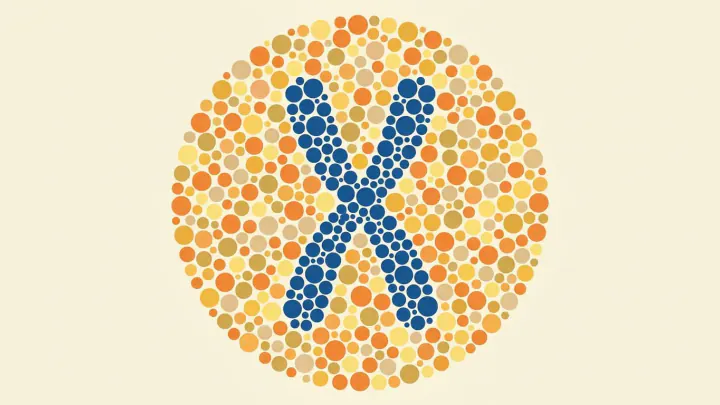
In the vast majority of cases, yes: color blindness is congenital, you are born with it. It is passed on through precise genetic mechanisms, mainly linked to the X chromosome, which explains why men are far more often affected than women.
Here are examples of “perfect” distribution depending on the parents’ combinations:
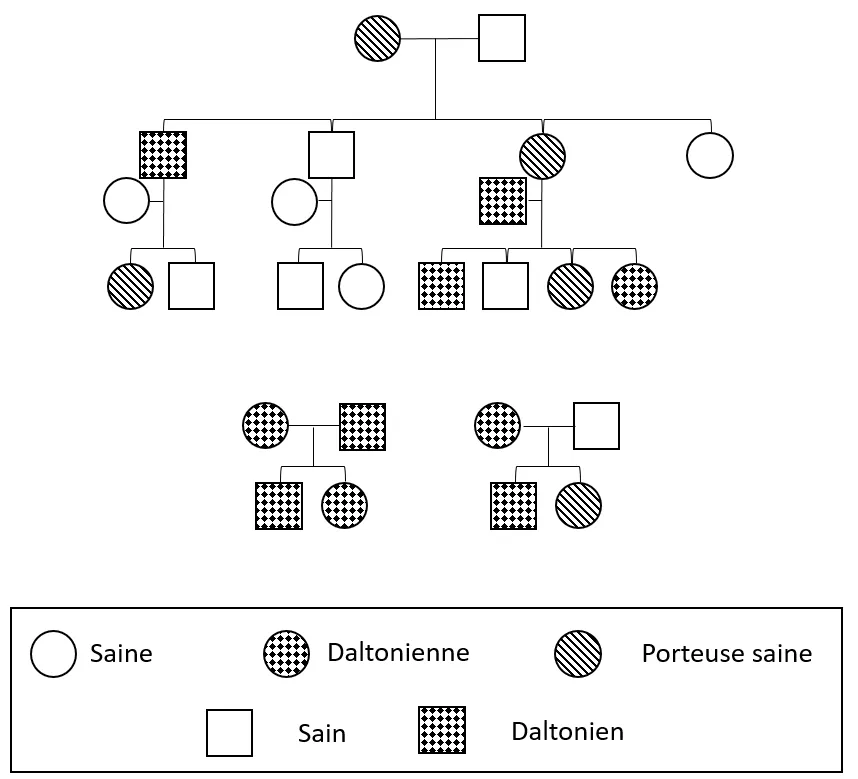
But “most often” is not “always”. Some diseases, some medications and aging can alter color perception over a lifetime: this is acquired color blindness (article in French), and it follows very different rules.
How many people are concerned? The figure everyone quotes, 8% of men and 0.5% of women, deserves a clarification that is rarely read: it was measured in populations of Northern European origin, it is not a worldwide average. The largest meta-analysis published to date (56 studies, more than 1.7 million participants, 21 countries) gives noticeably lower figures at the global scale: 4.38% of boys and 0.64% of girls⁴.
This also weakens the famous “300 million color blind people in the world”, obtained by applying the European 8% to the whole planet. With the meta-analysis rates, you land closer to 200 million. That is still a lot of people, but you might as well quote the right figure.
Inherited color blindness can’t be cured, but you adapt to it. And most color blind people lead a perfectly ordinary life, with simple strategies to get around the tricky situations.
What color blindness is not
To put the most stubborn misconceptions to rest:
- No, color blind people don’t see in black and white (except the very rare achromats)
- No, not all color blind people confuse red and green; some confuse blue and yellow, or other combinations
- No, inherited color blindness doesn’t get worse with age: it is stable for life. What does happen is that the lens yellows in everyone as they age, which degrades the discrimination of blues, color blind or not
- Yes, women can be color blind (article in French), even if it is less common
This blog exists to explore all these nuances, and to demystify a condition that, in the end, concerns something like 200 million people in the world.
Scientific sources
¹ Linhares JMM, Pinto PD, Nascimento SMC. The number of discernible colors in natural scenes. Journal of the Optical Society of America A, 2008;25(12):2918-2924. doi:10.1364/josaa.25.002918
² Linhares JMM, Pinto PD, Nascimento SMC. The number of discernible colors perceived by dichromats in natural scenes and the effects of colored lenses. Visual Neuroscience, 2008;25(3):493-499.
³ Pastilha RC, Linhares JMM, Gomes AE, Santos JLA, de Almeida VMN, Nascimento SMC. The colors of natural scenes benefit dichromats. Vision Research, 2019;158:40-48. doi:10.1016/j.visres.2019.02.003
⁴ Jeong YD, Cho J, Son Y, et al. Global Prevalence of Congenital Color Vision Deficiency among Children and Adolescents, 1932-2022. Ophthalmology, 2025;132(12):1431-1444. doi:10.1016/j.ophtha.2025.07.031