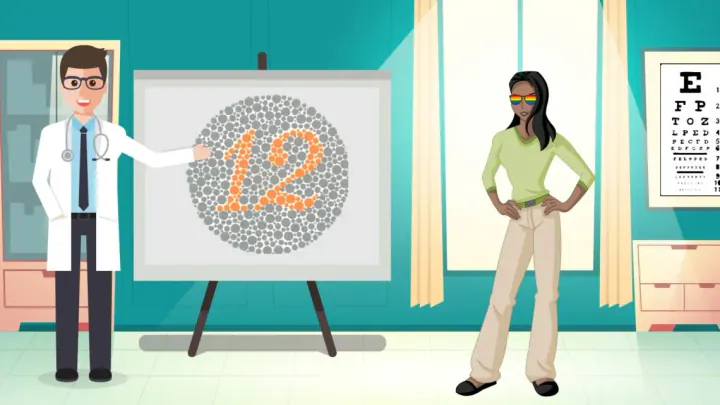
The Ishihara test is the best-known color blindness test in the world. Invented in 1917 by the Japanese ophthalmologist Shinobu Ishihara, it detects red-green vision deficiencies in a few minutes.
How does the Ishihara test work?
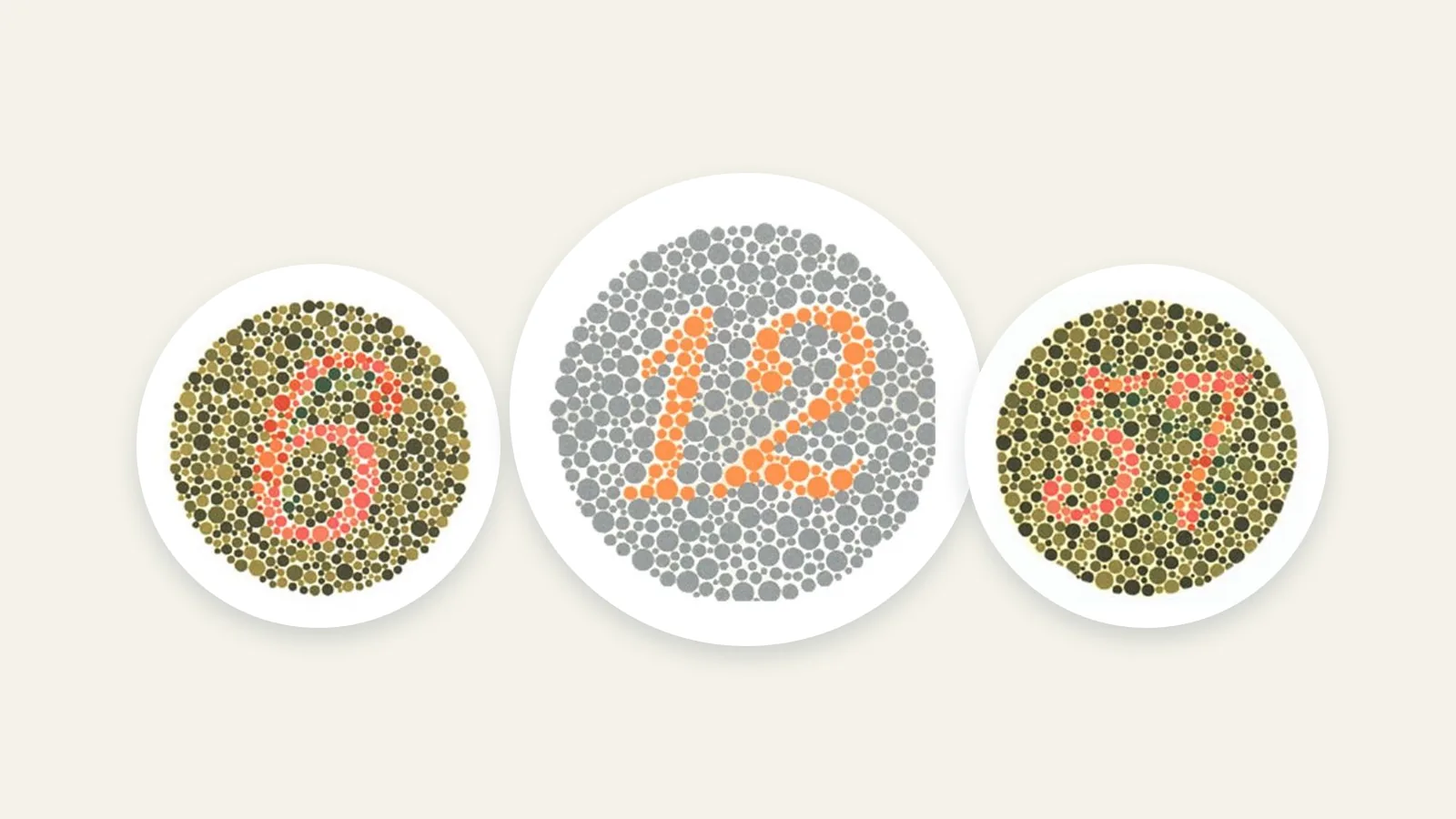
The test is made of circular plates made up of colored dots of slightly different sizes and brightness. On each plate, some dots form a number or a path, visible only if color vision is typical, or on the contrary only if it is deficient.
A few example plates:
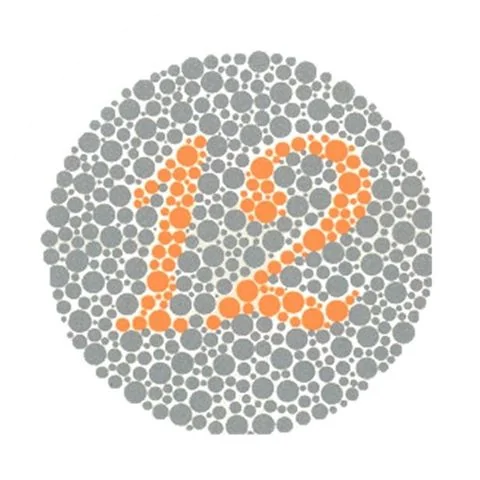
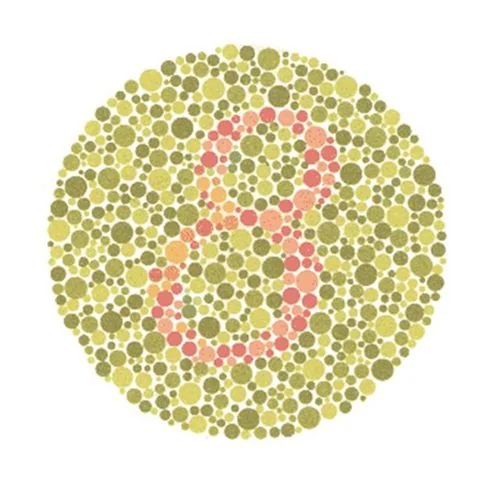
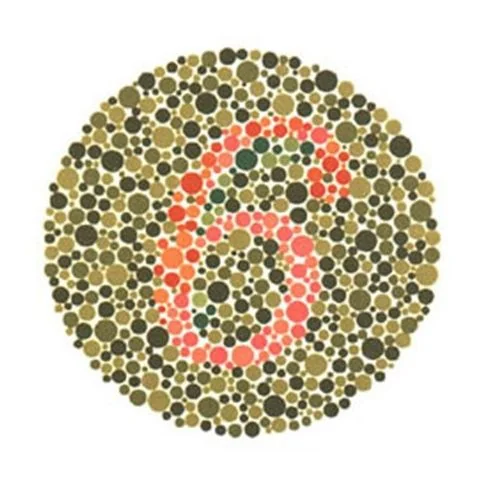
The principle relies on the difference in perception between the red and green cones. A person with typical vision sees the number formed by the colored dots. A color blind person sees the dots as a uniform whole, with no distinction, or sees a different number.
What the test detects, and what it doesn’t
The Ishihara test is designed specifically for red-green deficiencies: protanopia, protanomaly, deuteranopia and deuteranomaly.
It does not detect deficiencies of the blue cones (tritanopia and tritanomaly). If you think you have a difficulty with blues and yellows, this test won’t confirm it. To check this axis too, take the Chameleon test: it covers red-green and blue-yellow, with nothing to read. For a diagnosis, a Farnsworth-Munsell test or an exam with an eye doctor (article in French) are still needed.
Conditions for a reliable result
The accuracy of the online test is limited by the quality of the screen. To maximize reliability:
- Turn off blue light filters: f.lux, Apple Night Shift, Windows night mode, they all skew the colors displayed
- Take off tinted or filtered glasses: including the anti-blue-light lenses built into some prescriptions
- Wear your usual corrective lenses if you have an ordinary vision correction (nearsightedness, astigmatism, etc.)
- Set the screen brightness to a comfortable level, neither too dark nor dazzling
- Sit about 50 cm (20 in) from the screen
- Don’t spend more than 5 seconds per plate before confirming your answer
These precautions reduce false positives (thinking you’re color blind when you’re not) and false negatives (passing the test despite real color blindness).
Interpreting the results
An online result gives an indication, not a diagnosis. Variations from one screen to another, such as color calibration, color gamut and viewing angle, influence the results.
If the test suggests color blindness, confirmation should come from an appointment with an ophthalmologist, who has the printed version of the test under standardized lighting conditions.
If you can’t see the number on several plates but have never had any particular difficulty with colors in daily life, it is possible that your screen is poorly calibrated rather than you being color blind.
A note on the origin of the test
Shinobu Ishihara developed this test at the request of the Japanese army, which needed a quick way to identify recruits who couldn’t tell certain colored signals apart. The test is still the most widely used today in professional and school eye exams, more than a century after its creation¹.
This test was adapted and put online with the help of Stéphanie, who spent many hours separating each dot of the original plates to make a digital reproduction possible.
Scientific sources
¹ Ishihara S. Tests for Colour-Blindness. Handaya, Tokyo: Hongo Harukicho, 1917. Original publication of the test, designed at the request of the Imperial Japanese Army to screen recruits.