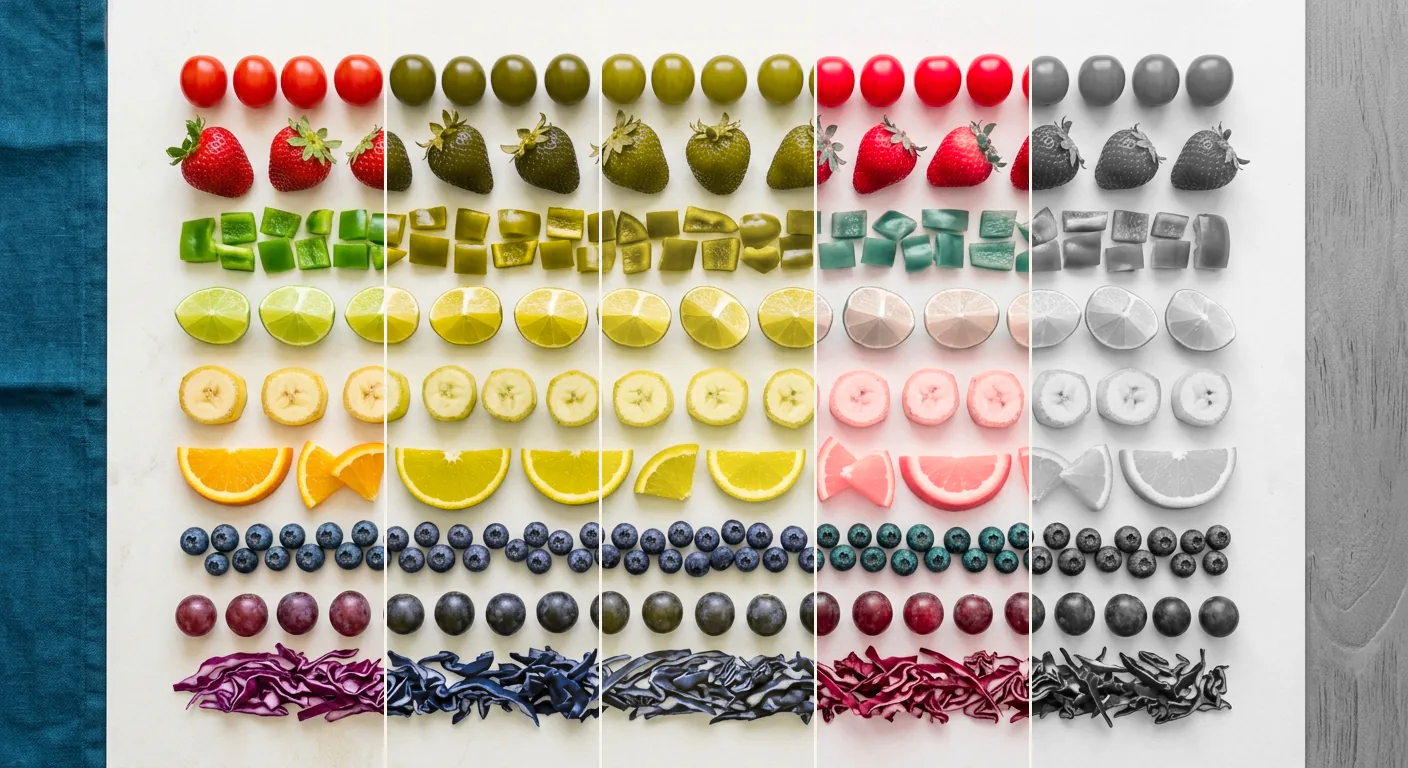
Contrary to a very widespread misconception, color blindness is not a single, uniform condition. There are several types, each one corresponding to the malfunction of a specific type of retinal photoreceptor.
The principle: faulty cones
The human eye contains three types of cones, each sensitive to a range of wavelengths (the full mechanism is detailed in our article on color vision):
- L cones (sensitive to orange-red)
- M cones (sensitive to green)
- S cones (sensitive to blue-violet)
Color blindness occurs when one of these cones works poorly or is missing. Depending on which one is affected and to what degree, the type of color blindness varies.

Red-green color blindness (4 types)
These are the most common forms. The genes responsible are located on the X chromosome, which explains why it is more common in men.
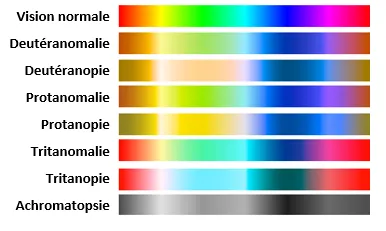
Deuteranopia
Complete absence of green cones. Green is perceived through the red cones only, which creates a marked confusion between red, green, orange and brown.

Prevalence: about 1 man in 100, 1 woman in 10,000¹.
Protanopia
Complete absence of red cones. Red and orange hues look dark, even black. The confusion mostly concerns red, green and brown.

Prevalence: about 1 man in 100, 1 woman in 5,000¹.
Deuteranomaly
The green cone is present but its peak sensitivity is shifted toward red. It is the most widespread form of color blindness.

Prevalence: about 1 man in 20, 1 woman in 250 to 300¹.
Protanomaly
The red cone is present but shifted. A milder form of protanopia.

Prevalence: about 1 man in 100, 1 woman in 5,000¹.
Blue-yellow color blindness (2 types)
These forms are much rarer. The gene involved is on chromosome 7 (not sex-linked), so they affect men and women equally.
Tritanopia
Complete absence of blue cones. Blue and yellow are confused. Blue shapes are perceived as green or pink depending on the context.

Prevalence: estimates vary widely between studies, from 1 person in 13,000 to more than 1 in 60,000¹.
Tritanomaly
Partial malfunction of the blue cones. Very rare: we devote a whole article to it (in French), since it remains so poorly known, even among eye doctors.

Achromatopsia
Total or near-total absence of working cones. The person sees only in shades of gray and is often very sensitive to light (photophobia).

Prevalence: about 1 person in 30,000 to 50,000¹.
Endless combinations
These seven basic types are only the main diagnostic categories. In reality, if you take into account the possible degrees of severity for each type and their multiple combinations, you easily exceed forty-six distinct configurations.
Every color blind person has a unique configuration. Two people diagnosed as “deuteranopes” don’t necessarily see in the same way. That is why it is always better to speak of color vision deficiencies in the plural, and not to reduce color blindness to a single clinical picture.
To see what each type actually looks like, the site’s simulator lets you switch between the different forms on an image of your choice.
Scientific sources
¹ Sharpe LT, Stockman A, Jägle H, Nathans J. Opsin genes, cone photopigments, color vision, and color blindness. In: Gegenfurtner KR, Sharpe LT (eds.), Color Vision: From Genes to Perception, Cambridge University Press, 1999, pp. 3-51, for prevalences by red-green and blue-yellow type (figures cross-checked independently against data published on colorblind.io and colordeficiencytest.com: protanopia ≈ 1.01% of men / 0.02% of women, deuteranopia ≈ 1.27% of men / 0.01% of women). For achromatopsia: Kohl S, Jägle H, Sharpe LT, Wissinger B. Achromatopsia. GeneReviews® [Internet], University of Washington, Seattle, 1993-2026. NCBI Bookshelf ID: NBK1418. For the overall prevalence and by family (red-green / blue-yellow) worldwide, see the meta-analysis cited in What is color blindness?