Color blindness is genetic in origin. You can’t modify an adult’s DNA to “fix” their faulty cones, at least not yet. But that doesn’t mean there is no solution. Several approaches ease the difficulties of daily life, though you first need to get a precise diagnosis (article in French).
Filtering glasses and lenses
Introduced on the market less than a decade ago, these optical devices are now the most accessible solution.
Their principle: filter out the wavelengths in the zone of spectral overlap between the red and green cones. By “removing” the ambiguous hues, the glasses improve the discrimination of the remaining colors.
How it works:
Without a filter, the response of a color blind person’s cones in the red-green zone is ambiguous: two different wavelengths produce signals too close to be told apart.
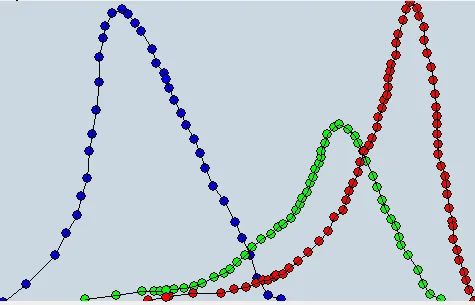
With a filter, the overlapping wavelengths are cut, forcing the remaining cones to work on more distinct ranges.

The filter therefore makes it possible to tell apart colors that used to be confused.
What they do: They improve the ability to tell apart certain hues that the color blind person used to confuse. Many users report a strong emotional experience the first time they see certain colors more sharply.
What they don’t do: They don’t give typical color vision. They filter wavelengths, they don’t add any. For a protanope (without red cones), the glasses can’t recreate a signal where the cones are absent.
Who they are for: These glasses work mainly for red-green color blindness. They are ineffective for tritan (blue-yellow) deficiencies. The manufacturer EnChroma claims that about 4 in 5 people with red-green color blindness would respond to them¹, a figure that comes from the company itself, not from an independent study. The clinical studies published on the subject show much more modest and inconsistent results: a measurable improvement on color discrimination tests for mild to moderate forms, but little or no demonstrated effect on severe forms, and no evidence of a change in color perception itself¹.
The main brands:
- EnChroma (American brand, a pioneer): around €500
- Pilestone: a more affordable range (€100-200)
- KOptical (French brand)
- Colorlite / VisionDesCouleurs
Prices range from €100 to more than €1,500 depending on whether the lenses are plain or built into an existing optical correction.
The Seekey
A lesser-known device, the Seekey is a small pocket tool using a double colored filter. Originally developed for sailors who had to identify light signals quickly, it makes it possible to tell apart colors that look identical to the naked eye.

Its main advantage: the price (around €36), far below filtering glasses. Its drawback: you have to use it actively, holding it in front of your eye, rather than wearing it all the time.
Mobile apps
Several apps use the smartphone camera to identify colors in real time:
- Chromaglass (often cited): identifies colors and can highlight them
- Color Blind Pal: simplifies colors to make them more distinguishable
- RGSee: displays the name of the colors the camera points at
These tools are particularly useful in one-off situations (choosing clothes, reading a map, identifying electrical cables).
Gene therapy
This is the most promising avenue in the long term. Doctors Maureen and Jay Neitz have been working on this subject since the late 1990s. In 2009, their team succeeded in restoring trichromatic vision in adult squirrel monkeys with red-green color blindness, by injecting into the retina a viral vector carrying the missing gene².
Human trials have not yet been approved on a large scale, in particular because of the risks linked to retinal injection (detachment, inflammation). But the results in primates remain a solid proof of concept.
Gene therapy is the only approach that could one day make it possible to “correct” color blindness at its source, rather than managing its effects.
In summary
| Solution | Effectiveness | Cost | Availability |
|---|---|---|---|
| Filtering glasses | Good (red-green) | €100–1,500 | Immediate |
| Seekey | Partial | ~€36 | Immediate |
| Apps | Situational | Free | Immediate |
| Gene therapy | Potentially total | n/a | Future |
No solution is perfect, but combining one or two of them covers most everyday situations.
Scientific sources
¹ The “4 in 5 people” figure comes from the manufacturer EnChroma’s own communication, and has not been reproduced by an independent study. Published clinical studies give more nuanced results, for example: Martínez-Domingo MA et al. Assessment of enhancement filters for color vision deficiency using a novel psychophysical technique. Optics Express, 2018. A 2022 meta-analysis concludes there is no clinically significant evidence of an improvement in the subjective perception of colors.
² Mancuso K, Hauswirth WW, Li Q, Connor TB, Kuchenbecker JA, Mauck MC, Neitz J, Neitz M. Gene therapy for red-green colour blindness in adult primates. Nature, 2009;461(7265):784-787. doi:10.1038/nature08401